Junior Mechanical Engineer
Mechanical Design & Engineering Delivery
- Support the design and development of mechanical components, assemblies, mechanisms, fixtures, prototypes, and test equipment
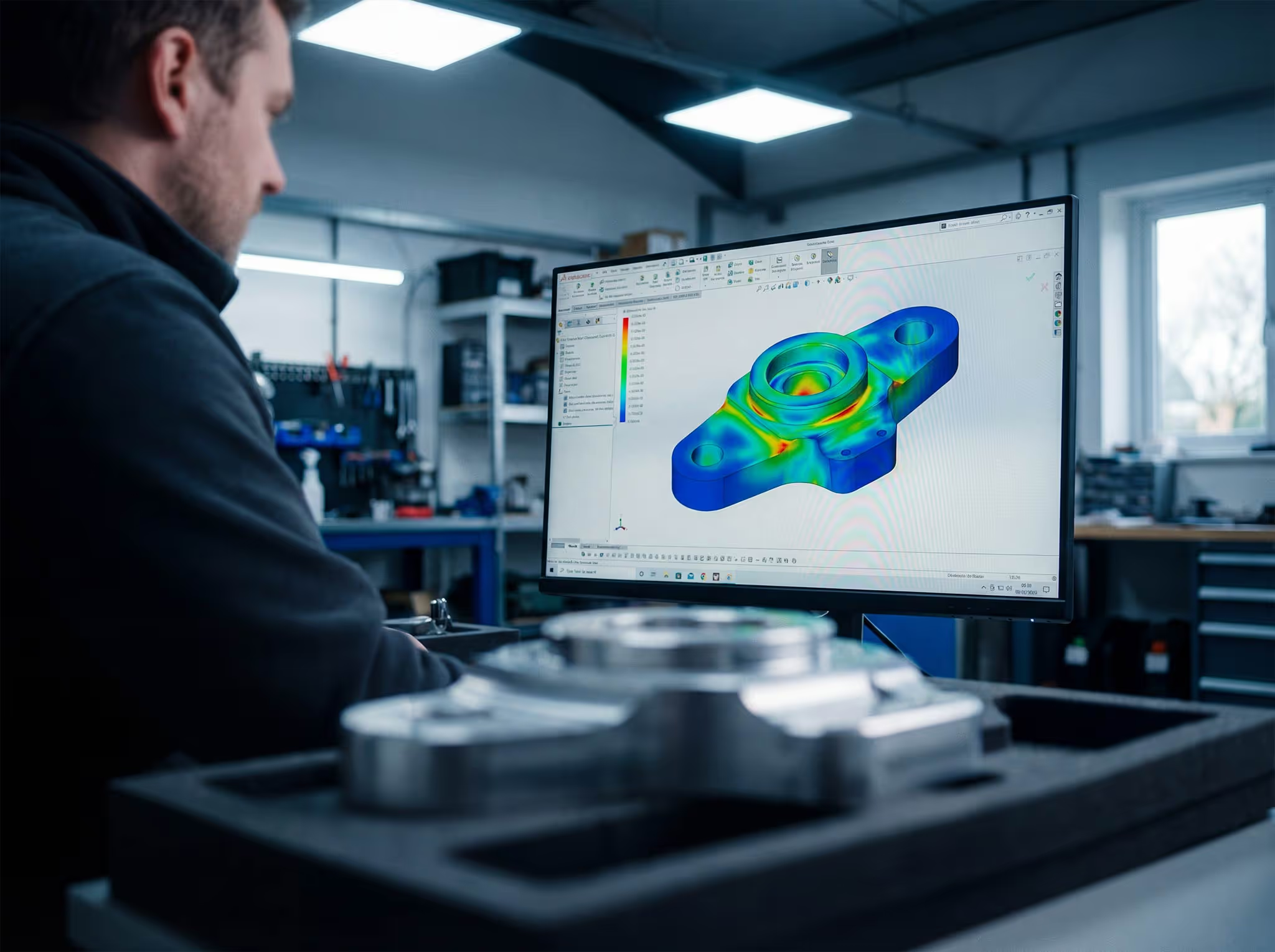
- Create and update CAD models and 2D manufacturing drawings under the guidance of senior engineers
- Assist with engineering calculations, component sizing, tolerance checks, and basic design validation
- Support material and component selection, considering function, cost, availability, manufacturability, and assembly requirements
- Contribute to prototype development, build, assembly, test, and design iteration activities
- Help identify practical design issues and suggest improvements based on engineering reasoning, test results, and feedback from the wider team
Project Execution& Collaboration
- Deliver assigned engineering tasks to agreed timescales and quality standards
- Work closely with mechanical, electrical, software, systems, and build/test engineers to support integrated project delivery
- Participate in design reviews, project meetings, technical discussions, and internal workshops
- Prepare and maintain supporting technical documentation, including BoMs, drawings, design notes, assembly notes, and test records
- Communicate progress, questions, risks, and issues clearly and proactively
- Learn to use internal project management, CAD, PLM, and documentation systems effectively
- UK Bachelor’s or Master’s degree in Mechanical, Aeronautical, Automotive Engineering, Product Design Engineering, or similar
- Graduate or early-career engineer, typically with 0–2 years of relevant industry experience
- Strong academic understanding of mechanical engineering fundamentals
- Working knowledge of CAD software, preferably SolidWorks
- Ability to create or interpret 2D engineering drawings
- Basic understanding of engineering calculations, component sizing, tolerances, and design for manufacture
- Awareness of common engineering materials, including metals, plastics, and composites
- Awareness of common manufacturing processes, such as machining, fabrication, additive manufacturing, moulding, casting, and assembly methods
- Familiarity with basic mechanical systems, such as fasteners, bearings, shafts, brackets, mechanisms, seals, and structural components
- Hands-on experience through industry, university projects, Formula Student, personal projects, workshop activity, prototyping, testing, or similar is strongly desirable
- Strong attention to detail and willingness to take ownership of assigned tasks
- Ability to learn quickly, ask good questions, and respond positively to feedback
- Good communication and interpersonal skills, with the ability to work effectively as part of a team
- Comfortable working in a fast-moving consultancy environment where projects, sectors, and technical challenges vary
Rewards & Benefits
- Competitive salary
- 8% pension
- Performance bonus scheme
- Comprehensive healthcare cover (extendibleto dependants)
- 36 days’ annual leave (inclusive of Bank hols.)
- TOIL policy
- Cycle2Work scheme
Development & Growth
- Significant opportunities for professional development
- Exposure to diverse, cutting-edge projects across multiple industries
- Mentoring and support from senior engineers
Culture, Team, & Environment
- Quarterly team days
- Annual company ski holiday
- A critical role within a thriving, ambitious, and innovativeorganisation
- Work alongside a close-knit team of exceptional people who excelin their fields
- Supportive working environment in an inspiring facility situatedin the Buckinghamshire countryside
To apply, please submit the following to careers@hooperquinn.com, using ‘V2603 – Mechanical Design Engineer’ as the subject of youremail:
1. CV
2. Cover letter outlining your suitability for this role and your motivation for joining Hooper Quinn
3. Response to the Application Exercises detailed below
You are welcome to include relevant work samples/portfolio in support of your application.
IMPORTANT:
1) Applications will not be considered if any of the three required documents is missing
2) Only applications submitted to the above email address will be considered
These short exercises are designed to give us an insight into how you think, communicate, and approach challenges, and equally, to give you a feel for the types of situations you may encounter in this role. Please ensure your responses reflect your own reasoning and experience. Submissions that appear to have been generated primarily by AI tools will not be considered.
Please take no more than 75 minutes tocomplete the exercises.
EXERCISE 1: Concept Design – Compact Actuation System
A client approaches Hooper Quinn with therequirement to design a compact mechanism to deploy a sensor mast from within asmall autonomous vehicle.
The mechanism must extend a sensor mastvertically from a stowed position inside the vehicle.
Requirement
- Linear extension: 120 mm
- Maximum load: 200 N
- Deployment time: < 5 second
- Available envelope for mechanism: 250 × 150 × 100 mm
- Power supply: 24V DC
The system may be subject to
- Vibration and occasional shock loads
- Outdoor operating conditions
- Repeated actuation cycles during testing and operation
Task:
Please describe a concept design for theactuation system and mechanism that could achieve this. (Note: we areinterested in your thinking and reasoning rather than a complete designsolution.)
Your response should include:
1. The type of actuator youwould propose and the reasoning behind your choice
2. The mechanism used to convertactuation into linear motion
3. A conceptual layout of themechanism (a simple sketch is welcome but not required)
4. The key engineeringconsiderations that would influence your design
5. Any technical risks orpotential failure modes you would investigate early in the design process
You may make any reasonable engineeringassumptions necessary in order to answer the question.
Please limit your response to 1–2 pages.
Sketches or diagrams may be included ifhelpful.
EXERCISE 2: Practical Engineering Experience
Please describe a practical engineering projectyou have worked on. This could be from university, industry, Formula Student, aplacement, a personal project, or another relevant setting.
Include:
- What the project was
- What your role was
- One technical challenge you encountered
- How you approached or solved it
- What you learned
Maximum: 250 words
EXERCISE 3: Culture & Values
In your own words, please select one of the followingvalues and 1) describe what that value means to you and how you put it intopractice in your day-to-day life; and 2) give a relevant example from yourprofessional experience where you have demonstrated that value:
- Tenacious Curiosity
- Efficient Agility
- Proactive Responsibility
Maximum: 300 words
Thank you for taking the time tocomplete these exercises. We appreciate the effort you put into yourapplication and look forward to learning more about you.
Hillesden
Buckingham
MK18 4BY
Royaume-Uni
///genius.tempting.special