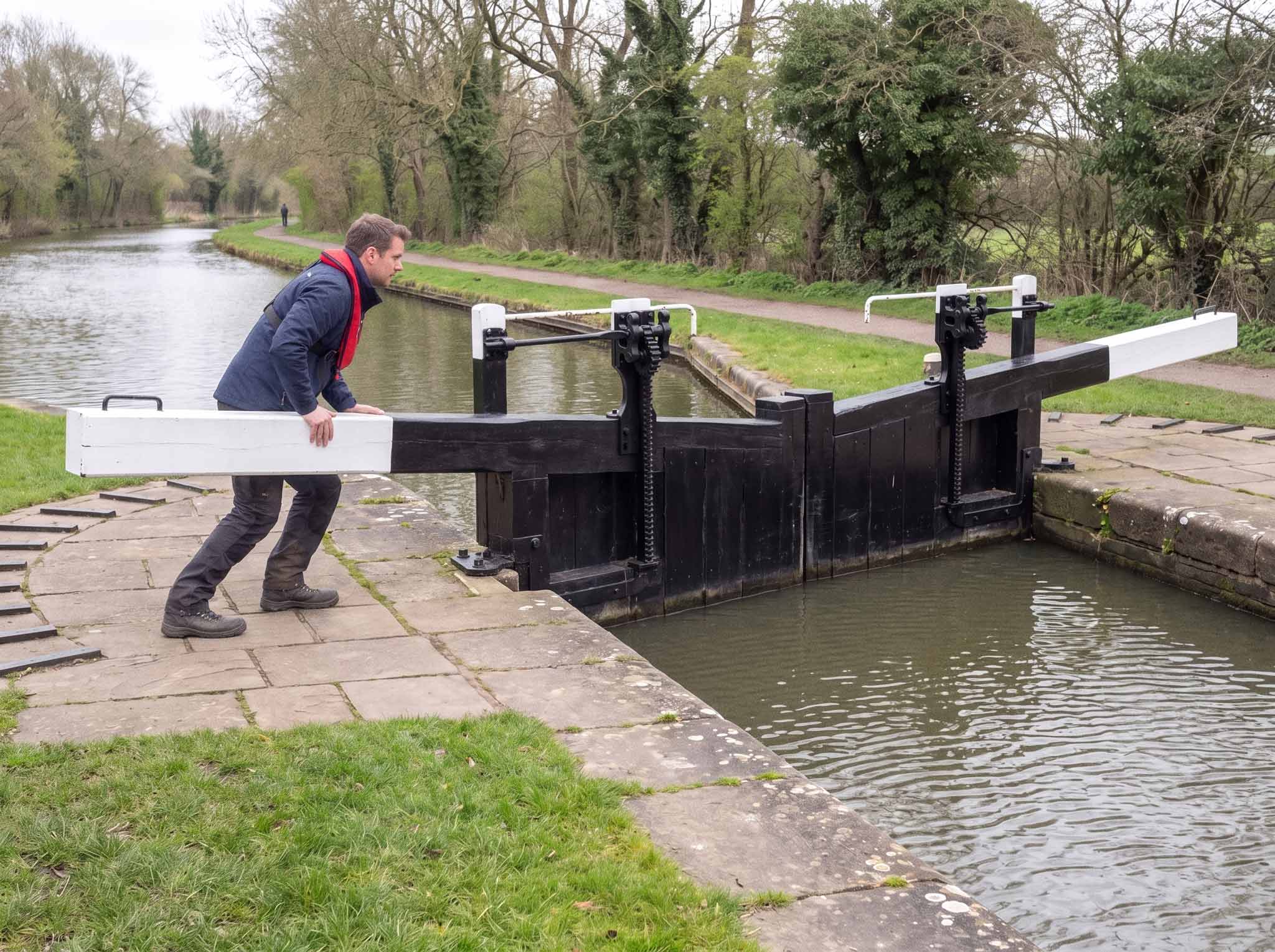
Legacy lock-gate gearing redesign
The challenge.
Lock keepers and waterway users depend on gate gearing operating reliably. A waterway authority asked Hooper Quinn to investigate recurring jamming in a family of lock-gate gearing and define a fix for both its single-gear and double-gear variants.
Years of repair and replacement had left a mixture of components whose combined geometry and fit needed to be re-established. The aim was to create a compatible replacement set that would reduce the recurring workshop adjustments needed during repair. With foundry patterns costly and slow to remake, the redesign also needed to be checked against the manufacturing process before committing to tooling.
Our approach.
Hooper Quinn analysed the complete gearing assembly: the pinion, rack, idler roller, back bearer and pinion mount. Reference points were taken from the gate itself so the assessment covered the mechanism and its interfaces without extending into the wider lock structure.
A tolerance-stack analysis traced the jamming mechanism to axial movement of the idler roller, which pushed the rack upwards into the pinion. The critical interaction involved the back bearer's taper geometry. This focused the redesign on component location and fit.
The redesign separated locating and constraining functions that had previously been combined. Changes included transferring lateral rack location from the roller to the pinion and inner web, giving the back bearer a plain bore, and introducing slotted holes and a setting tool for controlled adjustment of the pinion mount.
Design decisions were reviewed with the pattern maker to check manufacturability before the patterns were finalised.
What we delivered.
Hooper Quinn completed the engineering analysis and solution definition for both gearing variants. The redesign concentrated on the back bearer, roller, bracket and jackhead components and how they fit together.
The project is now in procurement support and validation, including foundry pattern-making and trial casting. The supplied photograph shows resin 3D-printed trial foundry patterns prepared for checking the redesigned geometry. Trial casting and validation remain to be completed, with documentation handover following that work.
Capabilities involved


Confidentiality.
Client identity and gate location are withheld.
Hooper Quinn Limited
Hillesden
Buckingham
MK18 4BY
United Kingdom
///genius.tempting.special