HQ resources
Product Development Guide
Product development is the process of delivering a new product - or improving an existing one
From early idea through to production. While every business tailors the journey, a core framework applies to most products. This guide is refined through work with engineering teams across multiple sectors, and is organised into five major phases, broken down into 26 practical steps.
Scroll through our breakdown of the five major phases of the Product Development Journey.
ideation
┐
01
ideation
┐
02
ideation
┐
03
project brief
┐
04
technical partnerships
┐
05
project planning
┐
06
patent application
┐
07
funding (round 2)
┐
08
product requirements, Analysis & Specification
┐
09
Proof-of-concept Prototype (theoretical simulation)
┐
10
concept design
┐
11
engineering quality control
┐
12
experimental prototype design
┐
13
funding (round 3)
┐
14
test equipment & facilities
┐
15
design validation
┐
16
performance & durability testing
┐
17
iterative prototyping
┐
18
user demonstration
┐
19
certification
┐
20
final design - full prototype & production
┐
21
funding (round 4)
┐
22
supply chain
┐
23
production quality control
┐
24
tooling trials
┐
25
first production units
┐
26
phase one
Ideation & Research
01
Ideation & Research
ideation
01
A “lightbulb moment” triggers an idea that solves a problem — or your company decides to develop the next addition to an existing range. Ideation is where early brainstorming and conceptual thinking begins to take shape into something testable.
Research & insight
02
To assess commercial promise, the concept is tested against the realities of its market and enabling technologies. Early research typically covers user needs, competitor analysis, target demographics, sustainability, and regulatory constraints.
Funding (Round One)
03
Initial seed funding is the first of several opportunities to finance the path to market. This may come from private investors, but can also include grants — particularly where a project delivers social or environmental benefit.
phase two
Project Engineering
02
Project Engineering
Project brief
04
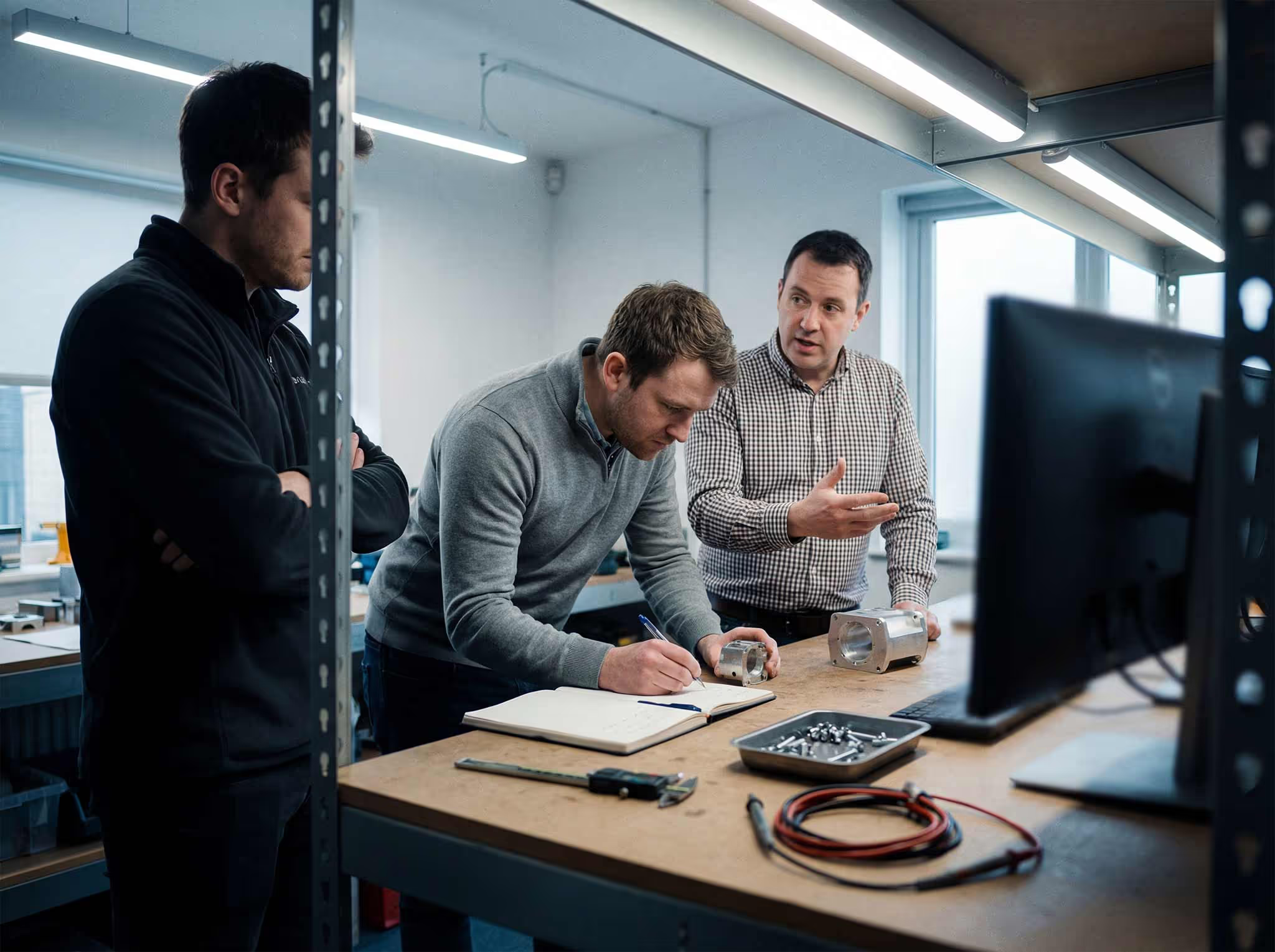
A project brief defines what success looks like and outlines the journey to a workable reality. Drafted and approved by a senior team, it should establish scope, indicative costs, and timelines for each phase. A clear brief aligns technical and commercial stakeholders — and materially improves the likelihood of success.
Technical partnerships
05
Following an initial consultation, a development partner should produce a technical proposal. Like a project brief, it clarifies responsibilities, defines deliverables, and highlights the key engineering challenges the partnership must solve.
Project planning
06
A project plan sets the most efficient route to deliver the brief, given available resources, people, and constraints. It establishes budgets and timeframes, identifies risk, and plans mitigation for foreseeable issues. Project engineering is the discipline of managing these moving parts throughout the lifecycle.
Patent application
07
Patent protection is often pursued after proof of concept, but in some cases it is initiated earlier — particularly if it strengthens funding prospects. A novelty appraisal helps position the product against existing technology, articulates what is genuinely new, and identifies what should be protected.
Funding (Round Two)
08
Shortcuts early in development often create disproportionate cost and disruption later. To support proof of concept and early engineering work, funding may come from programmes and bodies (e.g., Horizon Europe, Innovate UK), private investment, or crowdfunding.

phase three
Design & Engineering
03
Design & Engineering
Product requirements analysis & specification
09
Building on the project brief, product requirements define what the product must achieve — user experience, performance, cost, reliability, aesthetics, regulatory compliance, and safety targets. The product specification is the quantified, living document that defines how those requirements will be met. Done properly, requirements and specification align technical and commercial decision-making early.
Proof of concept prototype (theoretical simulation)
10
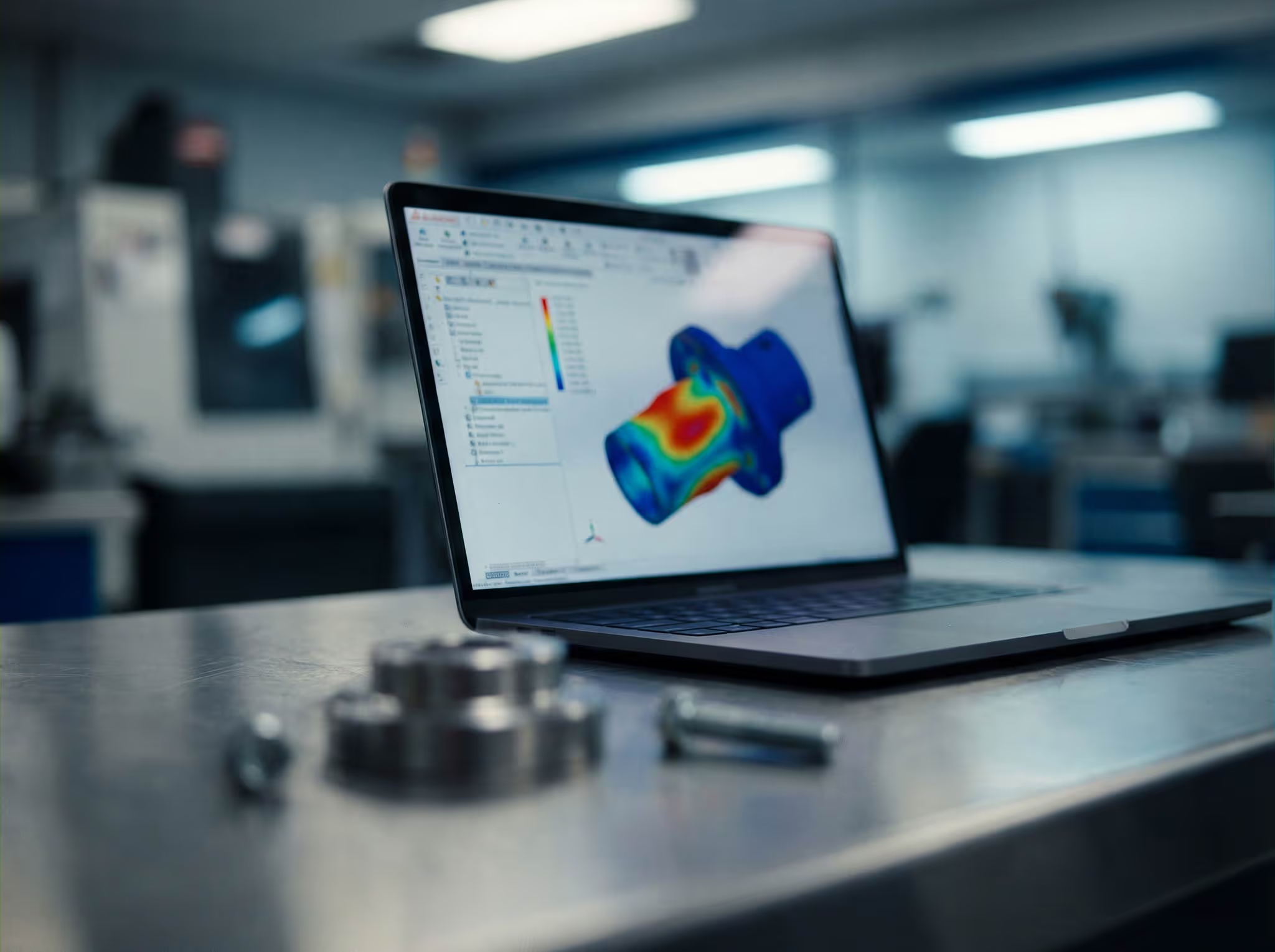
Proof of concept establishes whether the core technology can deliver the required function in the intended application. This may be a simple bench test, or a theoretical investigation where a physical prototype is not yet justified. Studies range from hand calculations (e.g., range estimates) to 3D simulation (e.g., flow modelling through a filtration system).
Concept design
11
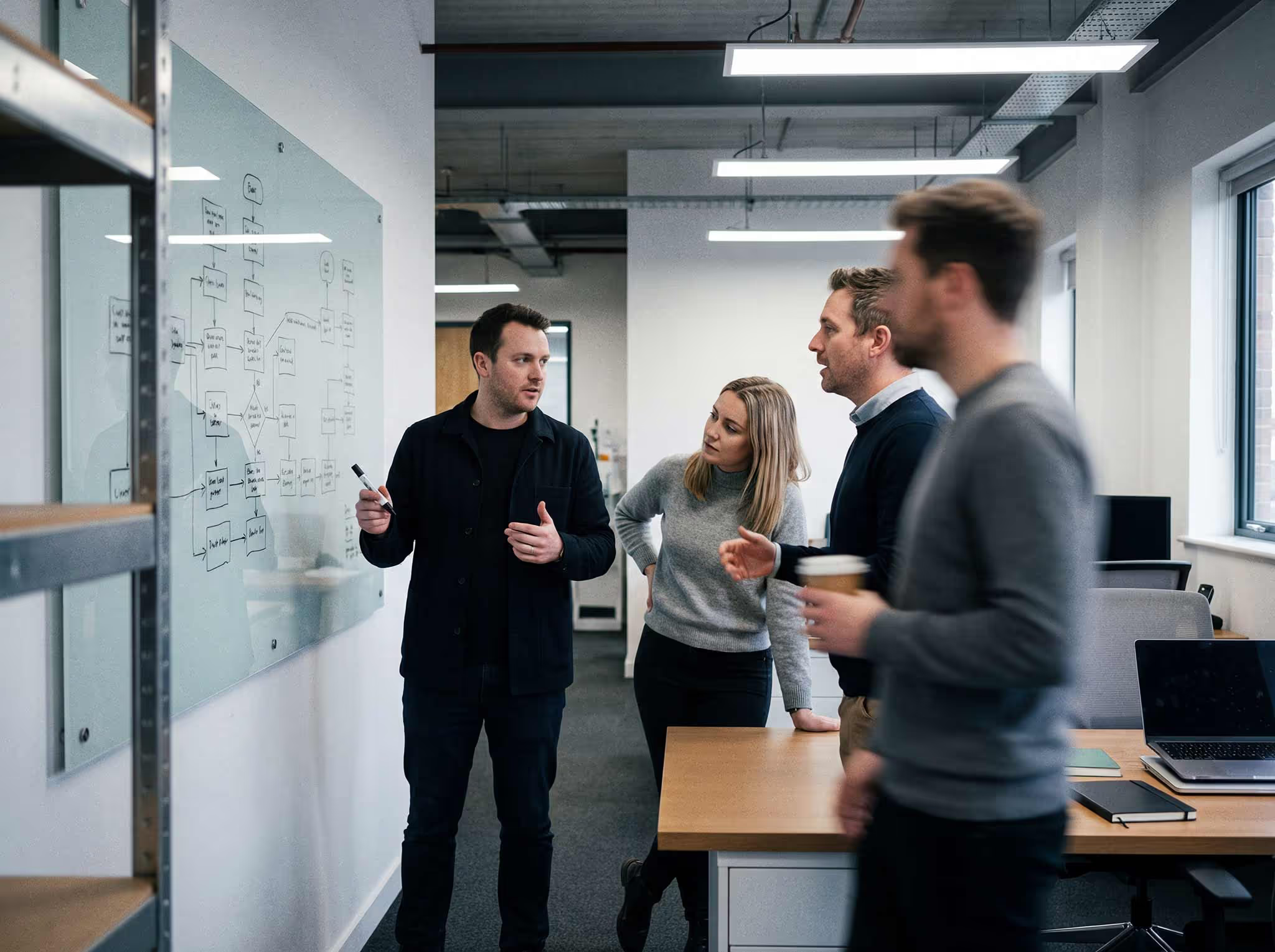
Concept design renders the overall product concept against the specification. CAD models make latent engineering challenges visible and create a medium to test solutions. Formal concept reviews provide a mechanism to make, track, and approve major decisions — and invite directors and stakeholders to refine or sign off the direction before detailed development.
Engineering quality control
12
Two overlapping systems underpin quality in product development:
1. inspection of physical attributes against defined standards; and
2. a corrective-action system that captures failures, investigates root cause, and prevents recurrence.
A well-run faults system is one of the most powerful tools in development. Where possible, learning from documented prior projects can reduce cost and time-to-market significantly.
A well-run faults system is one of the most powerful tools in development. Where possible, learning from documented prior projects can reduce cost and time-to-market significantly.
Experimental prototype design
13
Following concept approval, the design engineer develops a detailed assembly of manufacturable components, combining novel elements with proven technologies. Engineering reviews optimise for reliability and performance, while also reducing cost and manufacturing complexity. Outputs typically include manufacturing drawings, supplier quotations, a full bill of materials, and cost estimates for volume production.
Funding (Round Three)
14
With an experimental prototype design defined, the project is well positioned for investment. Funding should now be sufficient to carry the programme through iterative prototype builds and testing.
phase four
Product Development
04
Product Development
Test equipment & facilities
15
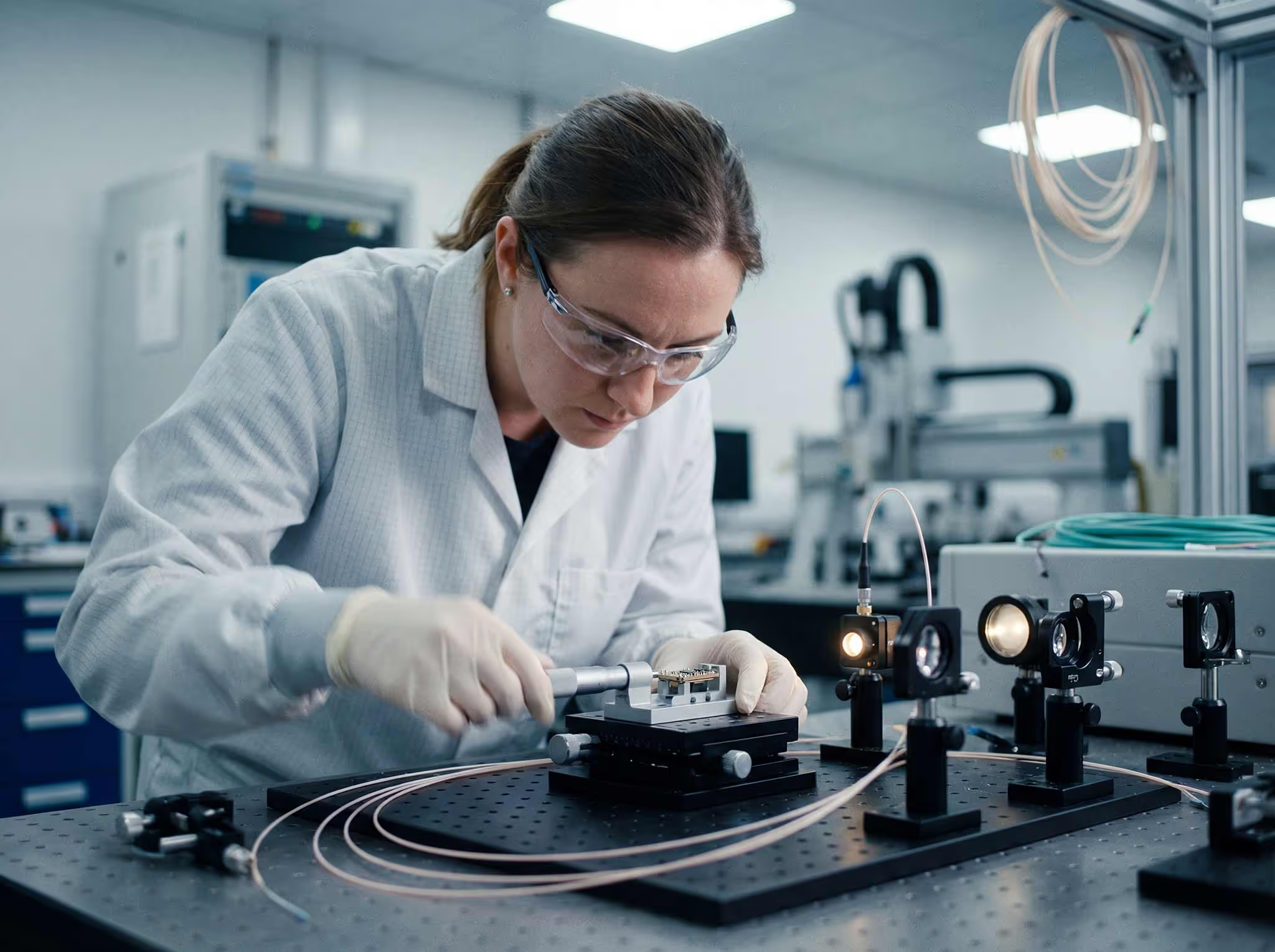
Define the equipment and facilities needed to measure quality and performance accurately. Without reliable measurement and the ability to explore design options through test, refinement can stall. Test capability can require meaningful resource and investment — especially where control, conditioning, or monitoring systems are required.
Design validation
16
Design validation confirms the product performs as intended against the requirements in realistic conditions. User-oriented testing assesses operation, ergonomics, and perceived quality. Internal build processes can also be evaluated to reduce future assembly time. Competitor benchmarking can reveal additional opportunities to refine the product.
Performance & durability testing
17
Durability testing exposes weaknesses by stressing the design in simulated environments and supports evidence capture and root-cause analysis. Accelerated programmes can compress lifetime learning into shorter timeframes. Performance testing measures primary behaviours (e.g., energy use, motor output, pressure drop).
Iterative prototyping
18
Insights from testing are fed back into the product specification. The design is updated to resolve failures and improve performance, then validation and durability/performance testing repeat until an acceptable balance of reliability, capability, cost, and manufacturability is achieved.
If you want a deeper breakdown of this step, see our dedicated guide.
If you want a deeper breakdown of this step, see our dedicated guide.
User demonstration
19
Once prototypes perform well in simulated and controlled tests, they should be evaluated by representative users. Ergonomics, ease-of-use, and safety are assessed, and user behaviour often reveals unexpected friction — or unexpected opportunity — that may justify another iteration.
Certification
20
When experimental and demonstration prototypes have proven robust, regulatory and compliance testing confirms minimum standards for durability, performance, and safety. Depending on the product and sector, these tests may be mandatory. Certification may include CE testing, UN testing, destructive testing, noise (NVH), or electrical isolation and EMC testing.
Final design — full prototype & production
21
Final design closes out the iteration cycle and optimises the chosen solutions for cost and time reduction in manufacture. Late-stage strategic or design errors tend to surface downstream as disproportionately large costs. Work here is typically focused on efficiency, waste reduction, and preparing all production quality processes.
Funding (Round Four)
22
To enter revenue-generating production, investment must cover materials, manufacturing tools, inspection equipment, and production line implementation. By this stage you should have a mature product and a clearer understanding of market potential and customer perception — which opens further funding options.

phase five
Production & Commercialisation
05
Production & Commercialisation
Supply chain
23
Most products require multiple suppliers with different capabilities. This phase establishes supply chains: sourcing, procurement management, part tracking, warehousing, and quality inspection processes. (If you’re keeping a service reference here, keep it light and link out rather than pitching inside the guide.)
Production quality control
24
An internal quality assessment system and inspection facility is typically required to maintain production standards, even where some bought-in parts rely on supplier QC. Quality engineers define inspection depth (from critical dimensions to stress testing), and set sign-off criteria for sub-assemblies and final inspection. Staffing commonly includes test technicians, supplier quality, and goods-in inspection.
Tooling trials
25
For the first time, units are produced using mass-production tooling. A final assessment proves the revised manufacturing processes and quality controls produce zero critical issues. Problems found here can materially affect delivery timing, so engineering support is often intensive.
contact
Start Your Journey
If you’d like Hooper Quinn to support any phase in this guide, explore our Services Directory or get in touch via our contact form.
Send us an enquiry using the form or contact us via:
Email: enquiries@hooperquinn.com
WhatsApp: +44 7454 955625
Our team will quickly get up to speed with your project and invite you for a free initial consultation to discuss your requirements
We will prepare a full technical proposal outlining how to get your project to where it needs to be.
You’ll hear back from one of our engineers - not a salesperson.
Email: enquiries@hooperquinn.com
WhatsApp: +44 7454 955625
Our team will quickly get up to speed with your project and invite you for a free initial consultation to discuss your requirements
We will prepare a full technical proposal outlining how to get your project to where it needs to be.
You’ll hear back from one of our engineers - not a salesperson.
Success! We’ll be in touch soon.
Something went wrong while submitting.
Hooper Quinn Limited
+44 1280 360427
Lower Farm
Hillesden
Buckingham
MK18 4BY
United Kingdom
///genius.tempting.special
Hillesden
Buckingham
MK18 4BY
United Kingdom
///genius.tempting.special